This post may contain affiliate links. If you make a purchase through these links, we may earn a commission at no additional cost to you.
Modern technology is causing measurable physical and mental atrophy. Studies confirm millennial grip strength has declined by roughly 20 pounds since 1985 due to sedentary lifestyles, while anxiety rates in young adults nearly tripled between 2010 and 2022. The solution is the “Sovereign Hybrid” model: leveraging tech without becoming dependent on it.
Look at your hands. Turn them over. Unless you work in the trades or lift iron for the sake of it, they are likely softer than your grandfather’s were at your age. This isn’t nostalgia speaking; it’s biology.
We tell ourselves we are living in the “Information Age,” a time of unprecedented human advancement. But if you strip away the screens and look at the human animal underneath, we are witnessing a collapse of capability. We have outsourced our navigation to satellites, our memories to clouds, and our physical resilience to an Uber arriving in three minutes.
We’re trading our autonomy for an easier life, but the bill is coming due. The currency isn’t bitcoin; it’s competence.
The Evidence: The Weakening of the West
This isn’t about “kids these days.” The data is undeniable.
1. The Physical Atrophy
We are physically withering. You can trace the timeline of this decay like a roadmap to ruin. In 1990, the analog world still demanded physical interaction and childhood obesity sat at a manageable 11%. By 2007, the release of the smartphone tipped our heads downward and kept them there. By 2016, the Journal of Hand Therapy published the receipts: millennial men had lost roughly 20 pounds of grip strength compared to their counterparts from 1985.
The pandemic years of 2020-2022 accelerated this atrophy, replacing the walk to the store with the “Buy Now” button and the gym with the couch. Today, in 2026, with testosterone levels having dropped approximately 1% per year for decades, we’ve successfully engineered a society where physical exertion is an optional hobby rather than a survival requirement.
Why? Because we don’t use our hands to manipulate the world anymore. We use them to tap keys and swipe glass. We have traded the mechanic’s wrench and the farmer’s plow for the thumb-scroll. When you lose grip strength, you lose a primary biomarker for overall mortality and resilience. We are building a society of people who cannot change a tire, fix a leaky pipe, or open a jar without mechanical assistance. That isn’t progress; that is dependency.
TACTICAL INTERVENTION: RECLAIM YOUR BODY
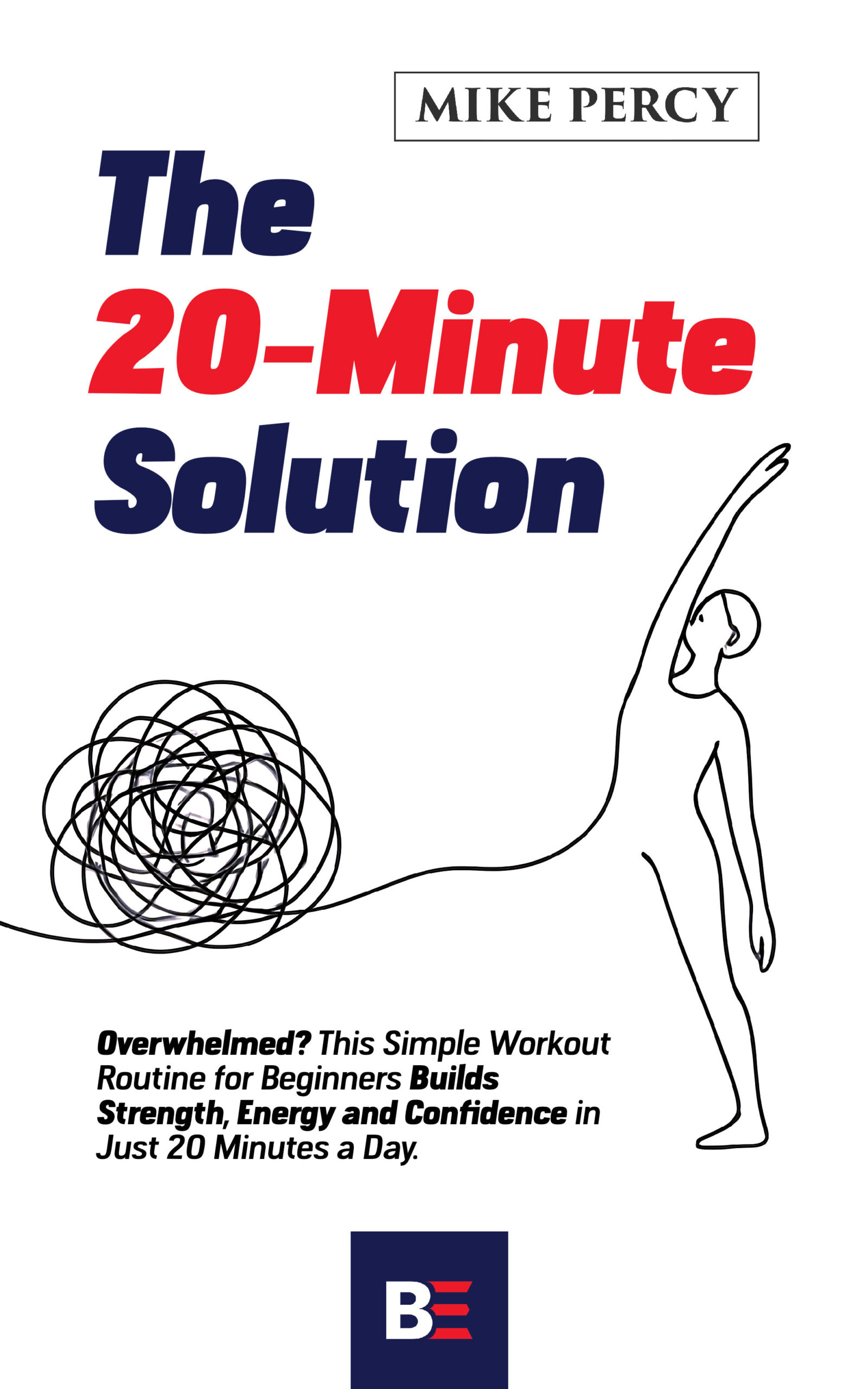
The fitness industry sells you a lie: that you need 90 minutes a day and a $200 gym membership to be capable. That “all-or-nothing” mindset is why most people quit before they start.
You don’t need a gym. You need a habit.
Mike Percy’s The 20-Minute Solution cuts through the noise. No expensive gear. No complicated routines. Just a “Foundational Four” bodyweight system you can do on your living room floor. It’s the antidote to overwhelm—a proven way to build strength, energy, and confidence in the time it takes to watch one sitcom episode.
Don’t wait for “someday.” Start with 20 minutes today.
2. The Mental Rewiring
The mental toll is heavier than the physical one. We aren’t just using these tools; they are using us. The average global user now spends 6 hours and 38 minutes per day on screens. For Gen Z, that number balloons to nearly 9 hours.
This constant connection has triggered a catastrophic rewiring of the human brain. Jonathan Haidt, in his analysis of the “Anxious Generation,” points to the early 2010s—the moment the smartphone became ubiquitous—as the inflection point. The data backs him up. According to the National Survey on Drug Use and Health, anxiety prevalence among Americans aged 18-25 exploded from 7.62% in 2010 to 19.9% in 2022.
But look beyond the clinical diagnosis to the societal blast radius. This explosion in anxiety has created a civilization-level vulnerability. A citizenry paralyzed by fear cannot take risks, cannot innovate, and cannot defend itself. We’re cultivating a generation that treats disagreement as violence and minor discomfort as trauma. When nearly one-in-five of your young adults—the demographic historically responsible for fighting wars, building industries, and pushing frontiers—are psychologically hamstrung, you don’t have a future. You have a managed decline.
We didn’t just get “more aware” of mental health; we built an environment hostile to it. We built a digital cage where algorithms feed us outrage and envy to sell ad space. If you’re spending 40% of your waking hours staring at a glowing rectangle, you aren’t living a life; you’re generating revenue for a data broker in Silicon Valley.
3. The Economic Serfdom
While we stare at the screens, our ownership of the physical world is being eroded. This is the “Subscription Economy.” You don’t own your movies; you rent them from Netflix. You don’t own your software; you lease it from Adobe. You don’t even own the heated seats in your BMW; you pay a monthly fee to unlock them.
The Bureau of Labor Statistics and market analysis firms estimate the average consumer now spends roughly $219 per month on subscriptions. We are drifting toward a feudal state where corporations act as the lords of the manor, and we are the serfs paying rent for the privilege of existing in their ecosystem. If you stop paying, you lose your music, your memories, and your heated seats.

TACTICAL INTERVENTION: AUDIT YOUR CHAINS
They want you to think it’s just $9.99 here and $14.99 there. That is the trap. The average American is bleeding $219 a month in recurring charges—often double what they estimate.
You cannot fight an enemy you cannot see. We built a privacy-first tool that acts as a financial x-ray. No bank connection required. No data harvesting. Just a cold, hard look at your monthly burn rate.
Stop guessing. Start cutting.
We treated the dystopian canon as fiction; Silicon Valley used it as a blueprint. Philip K. Dick, in Ubik, wrote of a future where a man had to argue with his apartment door for the right to leave without paying a fee. We laughed at the absurdity. Now, we live it. Orwell feared the boot stamping on a human face forever. Huxley feared we would be destroyed by the things we love. They were both right. We have voluntarily entered a cage because the Wi-Fi is strong and the door is automated—as long as you keep paying the monthly fee.
4. The Great Inversion: A Tale of Two Eras
We need to look back to see where we are going. Compare the trajectory of the individual from the Pre-1995 Era to the Post-Tech Reality.
The Tether Paradox
- Then (1995): The technology was tethered, so the human was free. The phone was bolted to the kitchen wall. When you left the house, you were gone. You were unreachable. That silence wasn’t a bug; it was liberty.
- Now (2026): The technology is wireless, so the human is tethered. You carry your leash in your pocket. You’re expected to answer emails at dinner and Slack messages at the urinal. You are never “gone,” so you are never truly present.
The Intelligence Flip
- Then: The technology was “dumb,” so the people had to be smart. If you drove cross-country, you needed to read a paper map, understand cardinal directions, and calculate fuel consumption. You were an active participant in your survival.
- Now: The technology is genius, so the people can be morons. The GPS tells you to turn left. The spellcheck fixes your grammar. The app tracks your calories. We have outsourced our cognitive load to the machine, and like an unused muscle, our native intelligence is atrophying.
The Physical Inverse
- Then: The screens were heavy, and the people were light. The television was a 200-pound piece of furniture that sat in one room. You watched it, turned it off, and went outside to ride a bike. Obesity rates were a fraction of what they are today.
- Now: The screens are weightless, and the people are heavy. We carry the screen everywhere. We don’t go outside; we simulate the outside on a 4K monitor. We have traded the calorie-burning friction of the real world for the sedentary ease of the virtual one.
Where is this headed? If we don’t break the cycle, we are moving toward a biologically secondary existence. A world where the algorithm makes the decisions, the robot does the work, and the human exists merely to consume the output. We are becoming the pets of our own creation.
The Sovereign Hybrid
The solution isn’t to throw your iPhone in the river. That’s a retreat, and we don’t retreat. The goal is a Strategic Counter-Offensive.
We can build an “enhanced” existence—a hybrid state where we possess the goods of the future but retain the grit of the past. We can use the very tools designed to enslave us to build our own fortress of competence.
- Invert the Tool: Use the algorithm to defeat the algorithm. Don’t just use YouTube to watch cats; use it to learn how to weld, how to frame a wall, or how to grow food—then turn it off and do the work. Use the GPS to learn the territory, then shut it down and navigate by memory. Leverage the unlimited information to build real-world competence, not just digital trivia.
- Reject the “Sheep Factor”: The subscription model relies on your fear of missing out. It demands you join the hive mind of the “Current Thing.” The ultimate rebellion is indifference to the hype. You can use the platform without swallowing the ideology. You can take the convenience—the Uber, the Spotify, the Maps—without taking the bait.
- The Hybrid Advantage: Imagine a human with the resilience of 1990 and the data access of 2025. That is the goal. A person who can fix a transmission and code a website. A person who is awake enough to use the technology as a force multiplier for their own life, rather than being used as a battery for someone else’s bottom line.
We don’t need to go back. We need to wake up. The future belongs to the capable—the ones who can still think, build, and endure. Be the master of the tool, not the servant of the screen.
The AI Force Multiplier
This philosophy extends to the “nuclear weapon” in the room: Artificial Intelligence. We are standing on the edge of a new era. You can cower, or you can conquer. The Sovereign Hybrid doesn’t ignore AI; they weaponize it to reclaim their time and quality of life.
- Outsource the Bureaucrat: Use the machine to handle the robotic work. Let it sort the data, draft the emails, and analyze the spreadsheets. Clear the administrative clutter that drains your soul so you have the mental bandwidth for deep work, leadership, and actual living. Serfdom is doing the robot’s job for it; strength is letting the robot do the chores so you can be human.
- The Infinite Sparring Partner: Don’t use AI to write your essay; use it to critique your logic. Don’t ask it to code your app; ask it to teach you the framework. It is the most patient tutor in history. Use it to sharpen your mind, not to replace it.
- Intentional Leisure: Technology often traps us in a “dopamine loop” of low-quality, algorithmic content. Break the cycle. Use AI to curate high-quality experiences—to find the obscure films, the complex history books, or the challenging video games that actually enrich you. Use the tech to pull what you want from the world, rather than letting the feed push sludge into your brain.
- The Commander’s Intent: Treat AI as a hyper-competent staff officer. You give the orders; it executes the logistics. You set the strategy; it crunches the numbers. But never, ever let it sit in the commander’s chair. If you stay awake at the wheel, AI becomes the ultimate engine for personal freedom.
We don’t need to go back. We need to wake up. The future belongs to the capable—the ones who can still think, build, and endure. Be the master of the tool, not the servant of the screen.
The Call: The Analog Rebellion
The choice is no longer between Luddism and Futurism. It is between being a user or being used.
You are standing at the precipice. Behind you is the comfortable, numb embrace of the algorithm, a world where you are fed, entertained, and slowly hollowed out. Ahead of you is the wild, friction-filled reality of the human experience.
I am telling you to choose the friction.
- Touch Grass (Literally): Put the phone in a drawer. Walk outside. If you cannot feel the wind or the cold, you are not really there. Re-inhabit your body.
- Build Something Real: Digital creations can be deleted with a keystroke. A table, a garden, a repaired engine—these things fight back against entropy. They prove you exist.
- Reclaim Your Attention: Your focus is the most valuable commodity on earth. Trillion-dollar companies are fighting to steal it. Defend it like a fortress.
The simulation is perfect, but it is dead. The real world is messy, painful, and hard, but it is alive.
Get your hands dirty. Get your heart rate up. Get busy living, or get busy scrolling. The screen will be there when you get back. Make sure you are strong enough to turn it off.